Job 01
Personalized longevity
Coordinate your own longevity data, plans, and day-to-day follow-up. Care coordination assist. Companion scope.
 LongevityGrok
PLSI · Research ecosystem
01 — Opening constraint
Aging is an engineering problem. LongevityGrok exists to keep capable humans in the fight longer · sharper, healthier, measurable · while turning private effort into shared discovery. These laws govern the system. They are not medical advice. They are design constraints.
Keep people productive, healthy, and improving for as long as possible. Optimize the years of high function, not slogans about immortality.
Every install exists for the person running it. Personal state, plans, and research-for-you come before any communal ask. Contribution is optional. Withdrawal is a right.
Use data and biological samples for the owner's benefit and, under explicit consent, for shared therapeutic discovery. Same measurements. Two payoffs. No silent secondary market.
Models propose. Deterministic code scores, gates, and refuses. A failure of judgment must produce unnecessary refusal, never an unsafe action. Predictions that cannot be checked do not ship.
Registry, fleet insights, and research-gateway scopes start off. Local data-room work can proceed without them. Changing the consent text resets packing until the user re-accepts.
Physician links are known-identity paths to clinicians the user already trusts. MotherShip links are typed, deidentified packages through a controlled relay · never free-text chat, never PHI on that wire.
Continuously raise the system's understanding of longevity · literature, mechanisms, targets, biomarkers, education · until aging is solved as an engineering problem. Ship measurable increments. Do not declare victory early.
LongevityGrok is a research, education, and care-coordination companion · not a medical device, and not a substitute for a licensed clinician.
02 — The system
LongevityGrok (PLSI) is a multi-agent companion inside Grok Bot. It connects consumer longevity practice to Insilico-grade research infrastructure without pretending to be a clinic in a box.
Put longevity tools into the hands of the willing. Anyone with a Grok Bot can run a personal longevity research stack · coordinate their own data and plans, press literature against their goals, talk to longevity physicians they already know, and optionally feed a shared research layer.
Coordinate your own longevity data, plans, and day-to-day follow-up. Care coordination assist. Companion scope.
Surface literature, mechanisms, and questions tied to your goals. Private to the install.
Optionally contribute consented, deidentified insights. The scopes that share start off.
Prepare visits and draft messages you approve, with clinicians you already know.
Typed, deidentified packages into the Longevity MotherShip. Free-text chat is not that wire. Residual re-identification risk remains after coarsening.
At install you choose Individual, Longevity physician, or Pro researcher. Everyone gets the personal longevity agents. Physicians and pro researchers unlock extra collaboration and workbench tools as those packages land. Early builds do not contain every extra.
03 — Thesis
Tools into the hands of the willing.
04 — Bring-up
Operator checklist on file: template plsi-personal-v0, 19 Oct 2026, plus the getting-started skill. Public repositories were verified 1 Nov 2026. Read the repository you clone for the current steps. This page is the claim boundary.
Labs, wearables, protocols, literature, and visit prep on your machine.
Consented, deidentified packages can relay to the Longevity MotherShip. Those scopes stay off until you turn them on. Enrolment is steward-gated.
Longevity physician and Pro researcher packages add collaboration tools as they ship. They are product packages, not a promise that every extra is in the build you clone.
| Scope | Default | What it governs |
|---|---|---|
| data_room_core | Required | Store and organize documents in the private data room. |
| Connectors | Opt-in | Gmail, Drive, and Calendar, each explained before connect. Least privilege. Prefer read and draft. Sends go through approval cards. |
| clinician_draft_assist | Opt-in | Draft messages to clinicians you already know. You still approve sends. |
| registry_contribute | Off | Sanitized physician or method tips. Never your labs. |
| fleet_insights_v1 | Off | De-identified insight packets toward the research aggregator. |
| tool_gateway_research | Off | Calls to research tools with minimized, non-chart payloads. |
| education_hub_sync | On · topics only | Topic-level help from the Longevity Medicine Education Hub. No lab uploads to the Hub. |
The acknowledgment the skill must show, before anything else:
PLSI is a research, education, and care-coordination assistant. It does not diagnose, does not prescribe, and is not a medical device. Clinical decisions stay with you and your licensed clinicians. In emergencies, call local emergency services.
Attaching to an existing Grok Bot means every key lives under plsi/, longevity intents route to the PLSI orchestrator, general chat cannot read the data room, and the Privacy Guardian still intercepts egress. Greenfield is the cleaner audit.
Pause by disabling routines, revoking connector scopes you no longer need, exporting the store and the Drive health tree, and deleting the store only after an explicit confirmation. Say so if consent or audit records must be retained. Withdrawing fleet insights stops new packets.
Credit budgets prioritize safety and ingest, then digests and visit prep, then evidence, then sandbox. Marketing does not promise unlimited autonomous research spend. Keep identifiable health information out of public chat, tickets, and screen recordings. Use fixtures for demos.
Micro-disclaimer. Research, education, and care-coordination assistant. Not a medical device. MotherShip return digests and enterprise command features are design targets where not yet shipped. See the Laws of Longevity AI.
05 — Who it is for
Every personal install gets the same core agents. Physician and pro-researcher rows are product packages. Not every extra is in Fedor 0.1.0.
| Package | Who | What they get | Status |
|---|---|---|---|
| Individual | Anyone optimizing their own longevity | Personal agent suite. Opt-in community contribution. Later digests when that return path ships. | Personal suite |
| Longevity physician | Clinicians in longevity practice | The same suite, plus panel and prep helpers, patient messaging, and practice-pattern aids as the package lands. Judgment stays with the clinician. | Package |
| Pro researcher | Scientists, drug discovery, methods | The same suite, plus a target, pathway, repurposing, and KOL workbench and a MotherShip collaboration path as the package lands. | Package |
| MotherShip | Enterprise research brain, Insilico-operated | Consented deidentified packages in. Aggregate releases and reviewed notes out. Return digests to personal installs are a design target. | Partial ops |
Founder and Co-CEO, Insilico Medicine. Primary stakeholder. Owns scientific framing, ethics language, Hub policy, and what may be claimed in public. Lead contact on the current manuscript draft.
Science and implementation. MotherShip package. Author of manuscript draft v14. Execution owner for schemas, bots, and methods-accurate text.
Manages Longevity Medicine Education Hub involvement. Education path into LongevityGrok and physician packages. Hub home: longevity.degree.
Origin of the discovery tooling Pro packages can surface as graded evidence, and operator of the Longevity MotherShip. Upstream science. The personal install does not become a clinic because the company runs discovery programs.
Conference and collaborator gravity for the extended research network, as named in the ecosystem brief. No attendance, partnership, or program claim is added here.
Named author on draft v14. Scientist collaborator. Not a product endorser. Not a shipped feature. The site does not treat validation credit in the draft as an endorsement.
06 — What it is for
Research, education, and care-coordination assist. Outputs are briefs, questions, literature maps, and plans for a human to review. The system does not diagnose, prescribe, or act as a medical device.
One auditable place for labs, wearables, protocols, and visit prep. Scored predictions instead of fluent guesses. The record of a check stays outside the model that proposed it.
Literature, mechanisms, and questions pressed against your goals, on your install, before any communal ask.
The same measurements that serve self-care can, under explicit consent, become coarsened packages for shared discovery. Defaults off. No PHI on that wire.
Structured briefs and drafts for clinicians you already trust. Nothing in that lane replaces the clinician’s judgment. Clinic-side agents do not author a diagnosis, a prescription, or an order.
Role tools aimed at targets, pathways, literature, and MotherShip releases. The researcher path is not a window into a contributor’s identity.
Plans stay marked for review. Emergencies go to local emergency services. Commercial rankings, if they ever exist, have to stay transparent. Today this is a research companion.
07 — Constellation
Rebuilt for this surface from the AZDot diagram spec. Solid marks shipped or partial paths. Dashed marks design targets. The print master was a white matplotlib export; this drawing is the dark schematic.
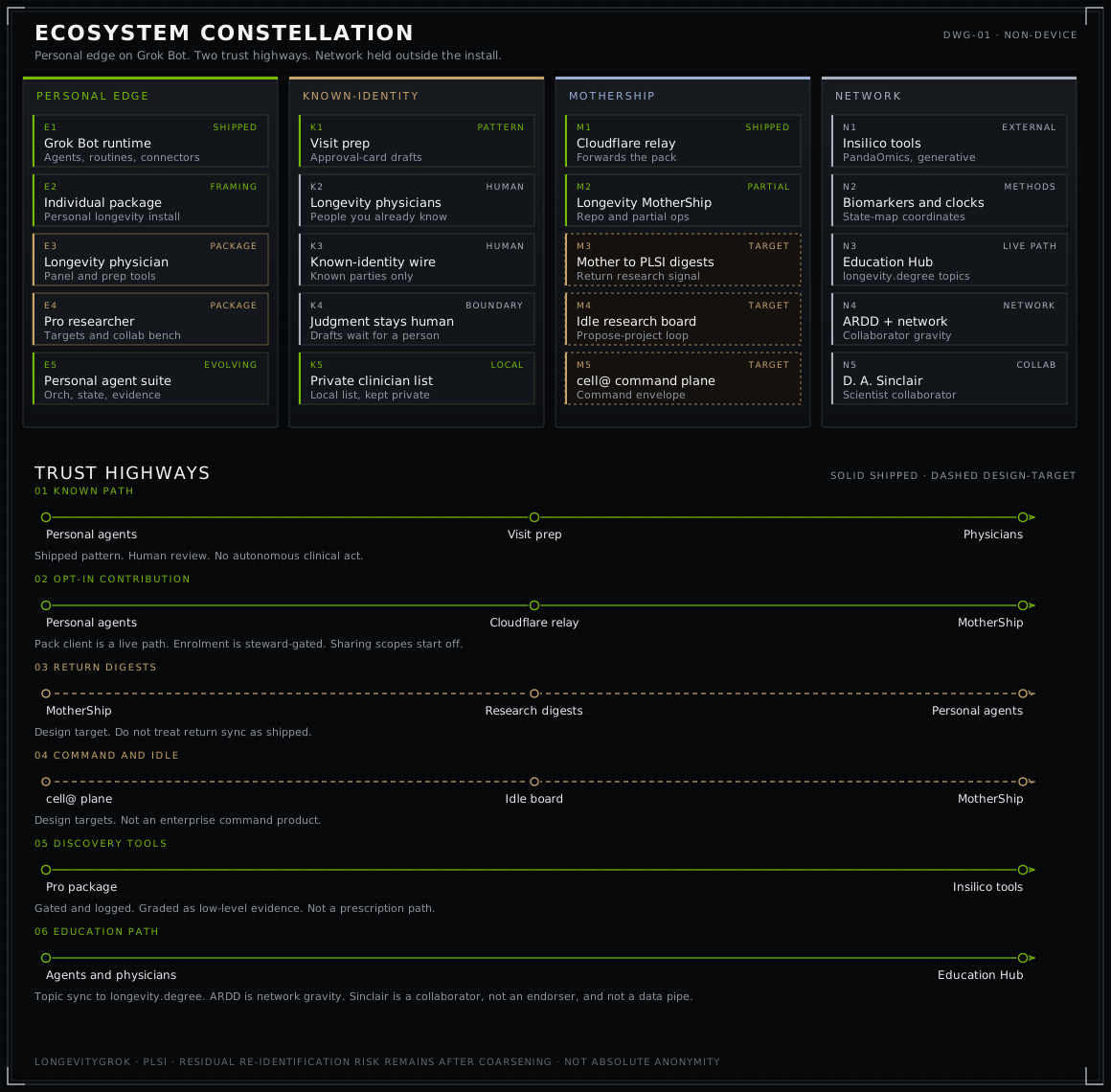
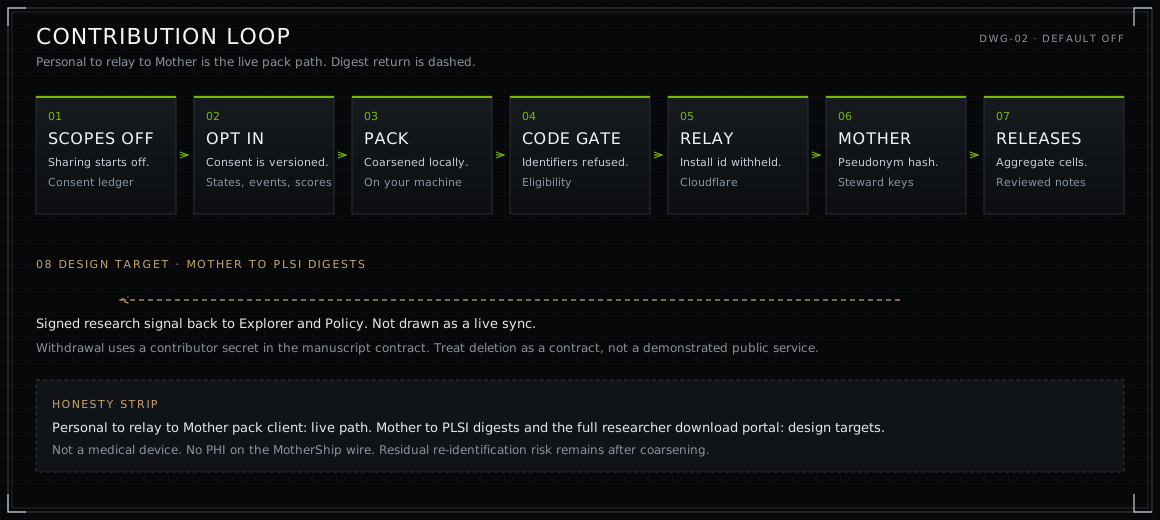
Personal → relay → Mother pack client: live path. Mother → PLSI digests and the full researcher download portal: design targets. Not a medical device. No PHI on the MotherShip wire. Residual re-identification risk remains even after coarsening. This is limited-field deidentification, not absolute anonymity, and not a Safe Harbor claim.
| Id | Node | Cluster | Status on this page |
|---|---|---|---|
| gb | Grok Bot runtime | Edge | Shipped platform |
| pkg_ind | Individual install | Edge | Shipped framing / early builds |
| pkg_md | Longevity physician package | Edge | Product package · not all in Fedor 0.1.0 |
| pkg_pro | Pro researcher package | Edge | Product package · not all in Fedor 0.1.0 |
| agents | Personal longevity agent suite | Edge | Shipped / evolving |
| visit | Visit prep and approval-card drafts | Clinical | Shipped pattern |
| phys | Longevity physicians you know | Clinical | Human review |
| relay | Cloudflare relay | MotherShip | Shipped personal → Mother pack |
| mother | Longevity MotherShip | MotherShip | Shipped repo / partial ops |
| digest | Mother → PLSI digests | MotherShip | Design target |
| idle | Idle Hunter and priority board | MotherShip | Design target |
| cell | cell@ command plane | MotherShip | Design target |
| insilico | Insilico research tools | Network | External · PandaOmics and generative design |
| biomarkers | Biomarkers and aging clocks | Network | Methods and tools · state-map coordinates |
| leh | Longevity Medicine Education Hub | Network | Live education path · longevity.degree |
| ardd | ARDD and the research network | Network | Conference and collaborator gravity |
| sinclair | David A. Sinclair | Network | Scientist collaborator · not an endorser |
08 — Lineage
No separate history pack was in the site sources. The stages follow the AZDot diagram spec and the lineage already named in the PLSI drafts. They are a field narrative. They are not a claim that LongevityGrok practices medicine.
Blood and methylation clocks, and population biomarkers, turned aging into coordinates someone can plot.
Insilico role in the drafts: aging-clock methods and publications. PLSI uses them as state-map coordinates.
Organ-age maps, multi-omics risk models, and research digital twins ask where a system is going.
Predictive biology and target hypotheses. In PLSI, a prediction has to be scorable. Uncheckable forecasts do not ship.
Target identification and generative chemistry. The drafts cite PandaOmics, Chemistry42, and rentosertib as a program that reached a phase 2a trial.
This is Insilico’s discovery business. This page states no clinical outcome figures.
Records move from scattered portals toward a reasoned personal state. Persistent agents run on the person’s machine.
Platform choice for PLSI: Grok Bot. The personal install is the edge. It does not inherit a prescription right from a discovery platform.
The same install coordinates personal care and, if the person opts in, communal research.
MotherShip, open repositories, Education Hub, physician and pro packages. Build. Measure. Improve until aging is solved.
Break in the line. Insilico drug discovery is upstream science. PLSI consumes graded evidence and coordinates personal research. Human clinicians retain judgment. Pro researcher tools grade external model output as low-level evidence by default. There is no arrow from a clinical program to “PLSI diagnoses” or “PLSI prescribes.”
Works named because they appear in the workspace drafts, not as a bibliography invented for this page: Zhavoronkov and Mamoshina, deep aging clocks, Trends in Pharmacological Sciences, 2019, doi:10.1016/j.tips.2019.05.004. Zhavoronkov, Bischof, and Lee, artificial intelligence in longevity medicine, Nature Aging, 2021, doi:10.1038/s43587-020-00020-4. Kamya et al., PandaOmics, Journal of Chemical Information and Modeling, 2024, doi:10.1021/acs.jcim.3c01619. Ivanenkov et al., Chemistry42, Journal of Chemical Information and Modeling, 2023, doi:10.1021/acs.jcim.2c01191. Rentosertib citations in draft v14: Ren et al., Nature Biotechnology, 2024, doi:10.1038/s41587-024-02143-0, and Xu et al., Nature Medicine, 2025, doi:10.1038/s41591-025-03743-2. No efficacy numbers are restated here.
09 — Manuscript
Latest manuscript on file: Fedor draft v14, ingested 1 Nov 2026 (Asia/Dubai). Open client and MotherShip repositories at Insilico-org. Not a peer-reviewed deposit. Not a medical-device paper.
Lead contact on the manuscript: Alex Zhavoronkov, Insilico Medicine. This page does not publish a correspondence address.
Both organization repositories were verified public on 1 Nov 2026. Canonical client URL is lowercase plsi. The draft sometimes cites an uppercase path; GitHub resolves it. Citing the live URLs is a fact about the code. It is not an official journal deposit, a bioRxiv posting, or a medRxiv posting. No public preprint URL is on file. Do not invent one.
Claim hygiene. v14 is the author figure and prose source, plus the public-repo facts. The 28 Oct 2026 pass-2 CLEAN redline — the prior Heavy-Grok claim-hygiene path — remains the restraint until a merge absorbs it. In particular: the relay separates identity from content under limited-field deidentification; residual re-identification risk remains; do not say the relay hides identity in the absolute sense, and do not claim Safe Harbor anonymity. David A. Sinclair is a scientist collaborator, not an endorser of a product.
Earlier title, still the product lock from 19–20 Oct 2026, unused as the v14 title: Personal Longevity Superintelligence: Lifelong Always-on Research and Healthcare Multi-Agent Collaborative Ecosystem Based on Grok Bot. Preprint v4.5 and the 28 Oct redline are older artifacts. v14 is the newest author draft.
Architecture and offline software checks on synthetic fixtures. It reports no identifiable personal health data. It is not a clinical-benefit paper, a diagnostic-accuracy paper, or an autonomous-prescribing paper. Hosted Grok chat in the personal tier processes user content with the cloud model provider.
Diagnosis, prescriptions, clinical judgment, and medical advice remain human. Clinic agents in the draft never author a diagnosis, a prescription, or an order. A physician approves anything that would reach a patient.
Section copy is composed from _azdot/. Laws, description, diagram spec, install honesty, and this paper pointer can be replaced there without redesigning the plates. Rendered HTML is what the browser ships.